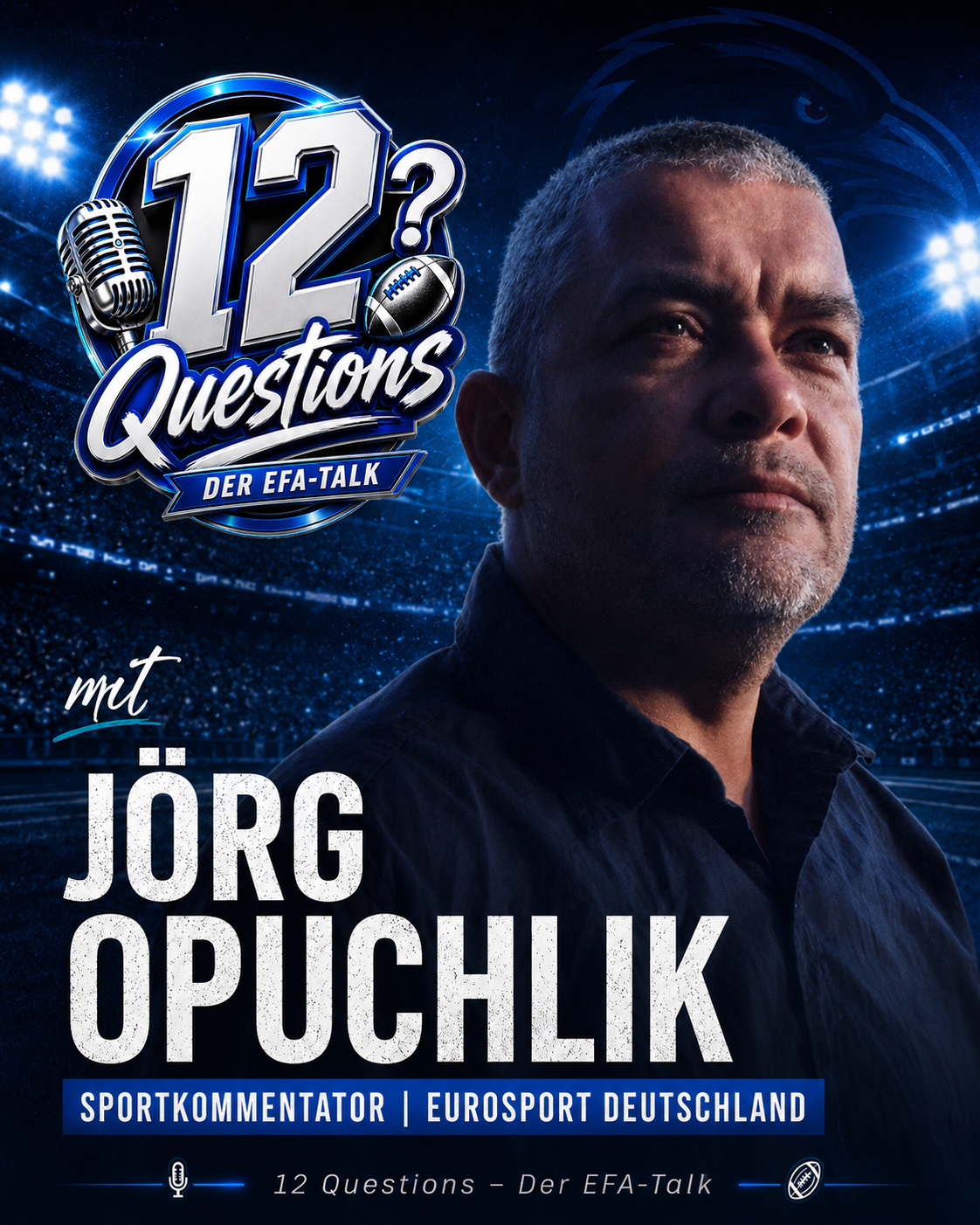
12 Questions – Der EFA-Talk with Jörg Opuchlik
Jörg Opuchlik is a sports commentator and has been active in the German sports media landscape for many years. In “12 Questions – Der EFA-Talk” he talks about his path into sports journalism, the fascination of American football, the role of TV, streaming and social media, and the future of European football.
In “12 Questions – Der EFA-Talk”, Jörg Opuchlik speaks about sports journalism, American football, TV, streaming, social media and the future of European football.
Jörg, how did you originally get into sports journalism and commentary?
Growing up in Berlin, I started in radio, although more in direction and broadcast operations. I then took my first annual vacation all at once and did an internship in the sports department — and then it was clear: this is it.
What fascinates you personally about American football?
The athleticism and action are obviously exciting. But the tactics — American football is called “chess with muscles” for a reason — fascinate me enormously.
How difficult is it to commentate American football for a wider audience while staying technically correct?
I have to explain a little, because I have worked for years and still work at Eurosport — and I have a role model there: Rolf Kalb, the snooker legend, now retired. He always managed that balancing act. He took newcomers along while also serving the experts, and that is what I try to do as well.
What makes really good sports commentary for you?
Good sports commentary has to be factually correct first. Then it has to carry emotion and atmosphere, and it has to be fun. Sport is fun, and that is exactly what I want to convey.
American football has become more visible in Germany and Europe. How do you see that development from a media perspective?
In 2026 there may be a small step back, because ProSieben MAXX and DAZN are no longer involved. But both leagues, EFA and AFLE, are doing everything they can to keep our sport visible.
What role do TV, streaming, social media and digital platforms play for the growth of football in Europe?
TV, streaming and social media are extremely important. Free TV alone matters to teams when they negotiate with sponsors or marketing partners. And both pan-European leagues are pushing hard. They are present on social media and very well positioned.
What does European American football need to gain more attention and acceptance long term?
It does not need that much more. The ELF may not have handled money well, but a lot was achieved in five years — that should not be forgotten. Beyond that, we need a league in which everyone pulls in the same direction.
Where do you currently see the biggest opportunities and challenges?
The biggest challenge remains money. If a team plays away, around 70 people travel. If it is a flight distance, flights, hotel and local buses can quickly add up to 40,000 euros for one away game. Even without flights, 70 people on the road are a major cost factor.
Is there a game, commentary assignment or sports moment that stayed with you?
The ELF semifinal in 2024: Rhein Fire at Stuttgart Surge. Heavy rain, freezing cold — but not a single spectator left. That was top entertainment. I would like to see more of that.
How important are personalities, stories and emotions around teams and players for new viewers?
That is the big strength of American football in Europe: fans and players are close to each other. Players do not just leave the stadium. They are ready for conversations, selfies and more.
If you could wish for one thing for the future of American football in Germany, what would it be?
The merger. I want all investors and leagues to work together and build one powerful league. That would be amazing.
What would you say to people who find American football interesting but have not found the entry point yet?
Go to the stadium. This sport is great on TV, but in the stadium it is something completely different. You can sit in a Galaxy fan block wearing a Paris Musketeers jersey and you will not be attacked or bothered with pyro nonsense. “Football is Family” still has a very strong reputation in the European football scene. So go to the stadiums with your kids and have a great time.
Many thanks to Jörg Opuchlik for taking the time for “12 Questions – Der EFA-Talk”.