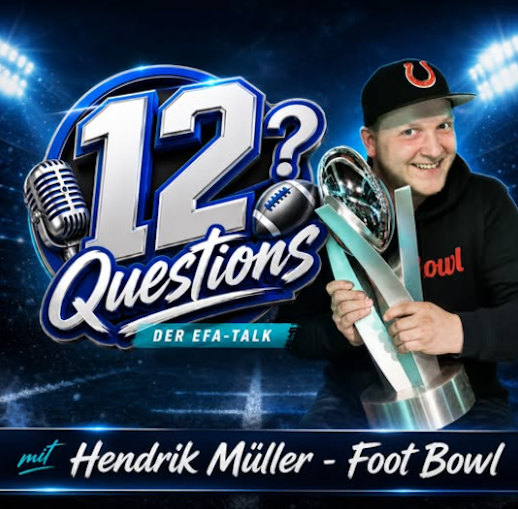
12 Questions with Hendrik Müller – Foot Bowl
Hendrik Müller from Foot Bowl has been covering European football for years, making stories visible and giving the scene a platform. In the EFA Talk, he speaks about his path into football, Foot Bowl, neutrality, EFA/AFLE, communities and the future of football coverage.
Hendrik makes one thing clear: European football does not only need scores, signings and headlines. It needs real stories, more depth, more cooperation and respect between all sides.
Hendrik, how did you first get into American football?
That was around 2012. A colleague at work told me about the Super Bowl back then. Before that, American football honestly was barely on my radar. You knew it from films, had a rough idea that it existed, but I had never really followed it actively. Through him I watched my first game and was immediately fascinated.
The following year I watched more and more games, first only the playoffs, then more regularly thanks to the broadcasts on ran. Around that time I also started to follow European football more closely.
What fascinated you about European football from the very beginning?
What fascinated me most was the closeness. Of course the NFL is the big role model, but in Europe you have the chance to be really close to the sport. You can talk to players, get to know them personally and gain insights you usually would not get. That makes the sport here extremely tangible.
At the same time, I never thought the quality was bad. In the first ELF season, the level was already okay and then improved significantly year by year. Of course there were individual teams you had to view critically, but overall the development was exciting.
How did the idea come about to build your own platform for European football with Foot Bowl?
That started before the first ELF season. There was simply very little information about players. You could still find something about imports, but almost nothing about many European players. That really bothered me. So I started asking questions myself and publishing the answers.
Basically, exactly what you are doing now. More and more people read our content because there were hardly any alternatives. Over time it grew bigger and bigger, and Foot Bowl became a real platform.
What has been the most beautiful or most exciting moment with Foot Bowl so far?
There have been many moments. The growth itself was already very exciting. At some point you realize that teams, franchises and other media notice you. When you are then quoted by bigger outlets like FAZ, Bild, ran and others, that is something special.
Even when content is simply copied, which is obviously not correct, it still feels in a way like a form of recognition. ran.de has done that once or twice in the past. Then there are campaigns, interviews and moments where you notice that your work has reached people.
Foot Bowl covers many teams, players and developments. How important is neutrality to you?
Neutrality is extremely important, especially in news and articles. Of course there are situations where emotions run high and you would like to criticize things very clearly. That happens mainly in formats like the web show.
But in classic reporting we really try to stay neutral 99 percent of the time. It never works completely without emotion because, at the end of the day, we are only human. But the standard is clear.
How difficult is it to be close to the scene and still treat all teams and players equally?
Actually, it is not that difficult. Every team makes mistakes and every team also does good things. We do not have problems with any team and we treat everyone equally.
No player is presented better just because he plays for a certain team. Respect is the foundation for us, and we get that respect back from the teams. That is why treating everyone equally is a no-brainer for us.
Are there certain stories or people in European football that have personally impressed you?
It is less about individual people and more about the stories behind them. During research, you keep discovering things you did not expect.
Players who were at the Olympics, others who took part in Ninja Warrior, or people with unusual life paths in general. Stories like that are extremely exciting. Players who use their attention to do something good also impress me again and again.
What defines a strong football community for you, whether in Frankfurt, Munich, Tirol, Vienna, Prague or anywhere else?
Respect for each other is the most important thing, regardless of the team. In football, that often works very well. A strong community stands behind its team no matter what the situation is.
A good example is the Barcelona Dragons. Even with few spectators, the support was extremely loud and passionate. That shows it is not about size, but about attitude. But big locations like Frankfurt, Munich, Tirol, Vienna or Prague also have strong communities that carry the sport.
How do you view the current situation in European football with EFA, AFLE and the different structures?
It is a very exciting situation. On the one hand, one big joint league would of course be ideal. On the other hand, competition forces both sides to improve.
Even if it is not openly admitted, the leagues are fighting to offer the better product. That can help the sport as a whole. Still, in the long term, a common structure would probably be the best solution.
What should leagues, teams, fan communities and media do better together so that European football keeps growing?
There needs to be more depth in reporting. Players should not only be introduced; their stories should be told. That makes them more tangible for fans.
Cooperation is also crucial. Media, teams and leagues need to work more closely together. If everyone pulls in the same direction, the sport will automatically continue to grow.
Which stories, people or developments in European football deserve more attention in your view?
National football in particular, for example the GFL, receives too little attention. It is the highest league, but many players are still in an amateur environment and get hardly any appreciation. That does not match the level of performance they deliver.
What message would you like to give to all fans who support football in Europe, regardless of league, team colors or location?
Stay with it, support your teams and the sport as a whole. No matter which league, which team or which location. Without the fans, football in Europe does not work.
A big thank-you to Hendrik Müller for taking the time to answer our 12 questions so openly and in such detail. Voices like his show why football in Europe is more than just a game.